
Humancentric Coaching
Methodology, Philosophy and Approach
The Humancentric Coaching Method
The Humancentric Approach
is the recognition and optimisation of the Human as a system, and its interaction with the systems around them. This coaching approach activates and leverages:
Awareness
Of who they are, who or what they are not, and what they want
Learning
Through self-discovery of their conscious nature as well as their unique system (“how they work”)
Change
Through evoking their inner resources, such as wisdom, capabilities, strengths and efforts
It is intentional introspection of the human system and the discovery of his/her unique construct.
Humancentric Coaching
achieves the above through the means of coaching, which distinctly involves:
- A partnership grounded on equal, co-created power and respect
- A process that guides the conversational flow
- A set of skills that results in effective change intervention
In Simple Words...
Humancentric Coaching helps you understand yourself — how you think, feel, and operate — and how that shapes everything around you. It works by drawing out what’s already inside you to create your desired reality.
The Premise
Humans Lie At The Center Of Their Universe
Human beings are the centre of the universe from only one perspective, and that is our own.
~ J. B. MacKinnon (Author)
The Humancentric Coaching approach recognises that the person is the control center of their life. Who they are, or believe to be, determines how they think, feel, and act. This in turn forms their reality. This process can be both a conscious one, and an unconscious one at varying degrees.
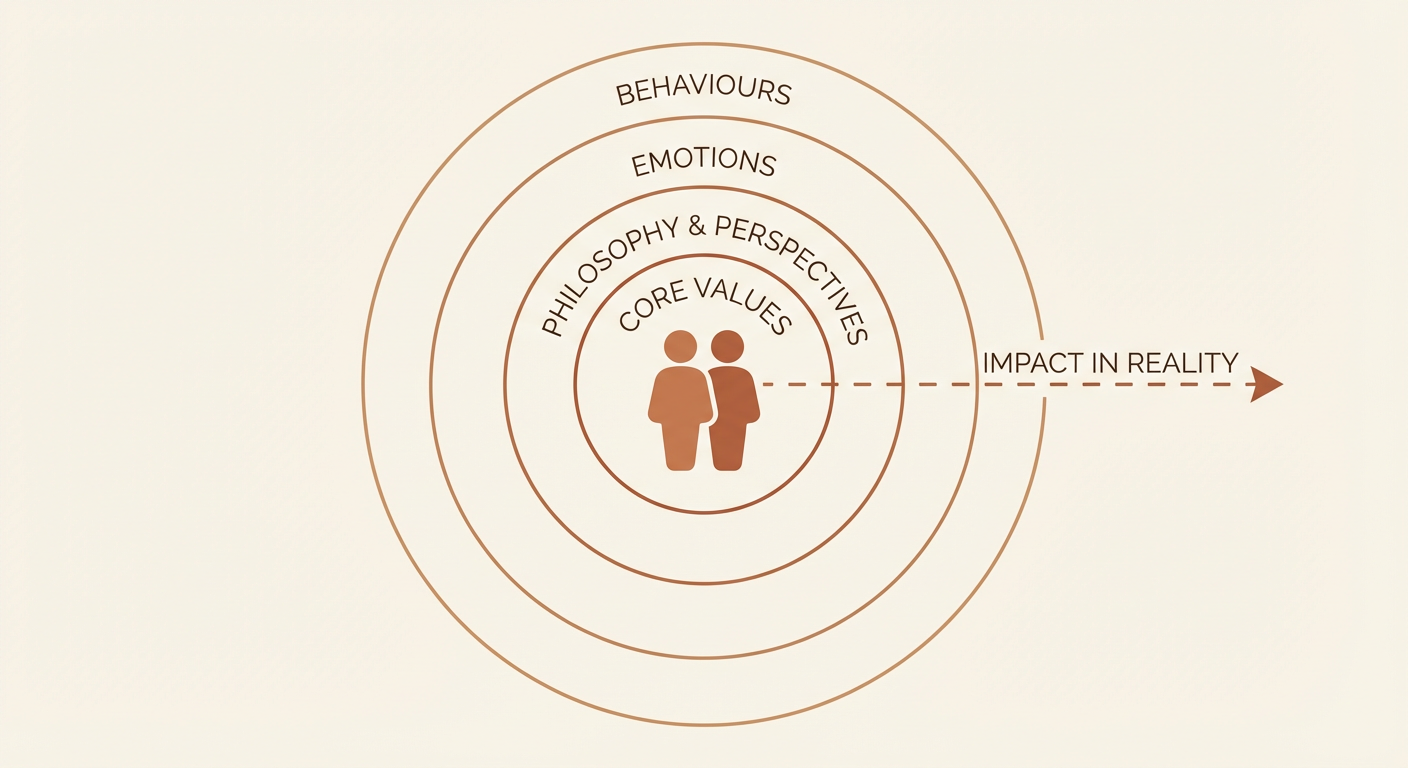
The Human System: From core values to impact in reality
Therefore, if one wishes to achieve fulfilment in life, then becoming aware and taking ownership of this process is a crucial ability to master.
Consider This...
We experience fulfilment in life through quality relationships, joyful work, meaningful hobbies and optimised health. In order to achieve these, we need intentional thought and effort. Simply acting in accordance to our defaults, whims and comforts will not get us there. Change is an inevitable process if we want to grow, improve and achieve what we dream of.
The Humancentric Approach Series
... is an exciting 5-week workshop series conducted online. Learn how to embody and apply the Humancentric Approach to what matters to you in your everyday choices and interactions. Highly experiential, you will be guided by passionate and experienced coach trainers through webinars and supervised peer practices. Join a community of like-minded coaches keen to grow and inspire those around them.
Why Humancentric Coaching Now?
We Got It All Wrong
We live in a world that has become extraordinarily good at solving problems. We have frameworks for strategy, tools for performance, and systems for almost everything. Now, AI can provide you the world’s knowledge in a split second to help you solve problems. Yet, many capable people still find themselves struggling — not because they lack knowledge, but because something more fundamental is missing:
Most of our challenges — in leadership, teams, marriages, friendships, parenting — are not problems to be solved. They stem from humans yet to be understood... including us to ourselves.
Core Principle
HCC focuses on the person — their Behaviours, Emotions, and Intellect — rather than default attention to the situation, the problem, or the task. This shift in focus is the foundation of Humancentric Coaching.
Why Now?
We are entering an era defined by artificial intelligence — one where tasks, analysis, and even decision-making are increasingly automated. The capacity that cannot be replicated is the deeply human one: the ability to be genuinely present with another person, to listen beyond words, and to help them reconnect with their own wisdom.
The Humancentric Coaching Method
An Essential, Timeless Method to Master
At the Center:
Recognising the person and their world. HCC coaches empower their clients through a person-centric lens, instead of a problem-centric one, choosing to place importance on coaching the person to overcome their own challenges by discovering their own unique success formula. This achieves sustainable change.
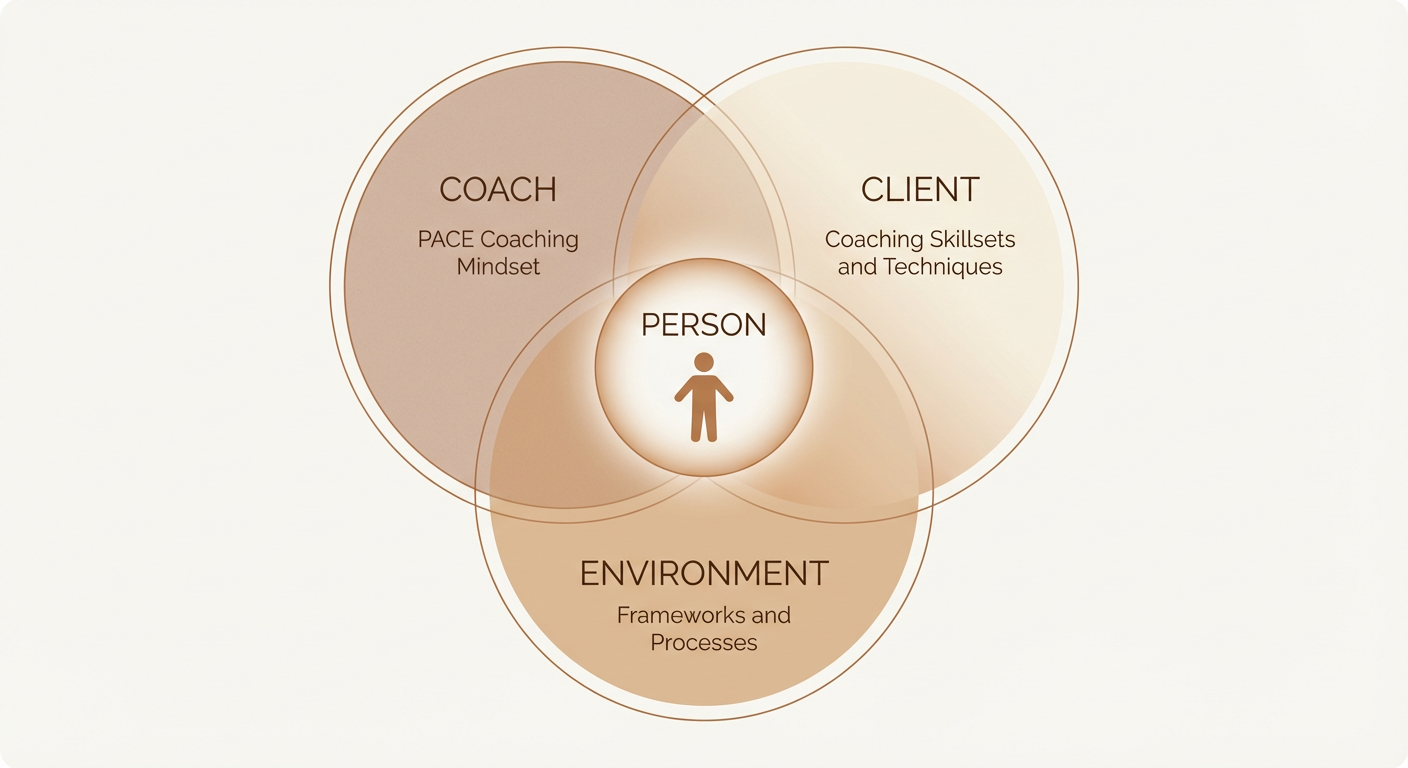
The Human System: From core values to impact in reality
The 3 Petals:
Emphasizes the partnership between the Coach, Client/Coachee, and the Environment. The 3 petals form the system that helps the partnership flourish. HCC coaches are trained to co-create and co-manage this partnership with stakeholders to ensure safety and effectiveness.
The 3 Circles:
Present the disciplines required in coaching mastery. Mindset shapes the way the HCC coach thinks and views their client from. This coaching mindset informs the behaviours, choices, words and language, approach and skills used to create a powerful change intervention. Skillsets, techniques, frameworks and processes help the HCC coach become more precise and competent in their art. This journey is both rewarding and personally fulfilling.
The Humancentric Coaching Certification Program
... is a transformational 4.5 month certification program that graduates you at the professional standard of coaching. It offers the pathway to obtaining the Associate Certified Coach credential awarded by the International Coaching Federation. It blends deep human development with rigorous coaching skill-building. You'll learn through immersive workshops, real coaching practices and clients, personalised mentoring, and a supportive community of peers and faculty.
In Practice
What Does This Actually Look Like?
Sometimes the most powerful way to understand a new philosophy is through the lens of something familiar. These scenarios capture different aspects of the Humancentric Approach.
The Gardener, Not the Mechanic
A busy leader is stopped by a team member who looks anxious and stressed. The team member shares his concerns about meeting an important deadline. Instead of telling him what to do and how to do it (fixing the problem), the leader applies a Humancentric Approach by recognising this is important for him enough to raise this. The leader chooses to take 5 minutes out of his busyness to check in on the team member's welfare. He then asks, "What do you need in order to tackle this in a calm and clear manner?", and waits with patience as the team member reflects on his best strategy forward.
Teaching a Child to Tie Their Shoelaces
A mother comes back from a hectic day at work, exhausted. She finds her primary school daughter watching TV, with the day's homework still untouched. She feels the anger and impulse to scold the daughter. Recognising that approach may only make the situation worse, she breathes, and chooses to focus on what matters — empowering the child to take ownership of their responsibilities. She gives her daughter a hug, says she's happy to see her, turns the TV off, and asks her child, "How long would you need to get ready to start on your work? 5 seconds, or 5 minutes?"
The Driving Instructor, Not the Backseat Driver
A colleague comes to you with a dilemma. He's unhappy in his current team, and an opportunity to move to another department has presented itself. He insists it's best he moves, even though he knows that he won't like the work or the long hours there. You already sense the dread and unwillingness, and notice that while the decision seems logical, he's not fully owning the decision. You feel that you know him very well, but choose to hold back the urge to share your opinion and convince him to reconsider. Instead, you ask him questions to weigh the pros and cons. You challenge his notions by asking neutrally, "What have you noticed about yourself so far in high-pressure environments like the new one?", and give him the space to reflect and understand himself better. Based on a true story, this colleague eventually realized on his own accord that making a rash move just to escape the current situation will have a backlash on him, and comes up with a strategic plan to gather information in order to make a more informed decision.
Coaching The Person, Not The Problem
A client comes into the session and shares excitedly that she's been nominated to deliver an important presentation at the upcoming company D&D. It's her first time. She's pleased with the opportunity, but very, very nervous. You happen to be experienced in giving talks to hundreds yourself, and have delivered well-received talks. In fact, you love the topic so much that you watch and analyse TED talks frequently. However, you recognise that this isn't about you and how much you know as her coach. You bring your focus back to coaching her to grow big enough to take this challenge on with confidence. You smile, congratulate her, and ask, "What can we work on together to ace this big opportunity you've been given?" She thinks for a while, lights up, and replies, "I want to feel like I can answer to myself at the end of the night, that I did more than I imagined I could!"